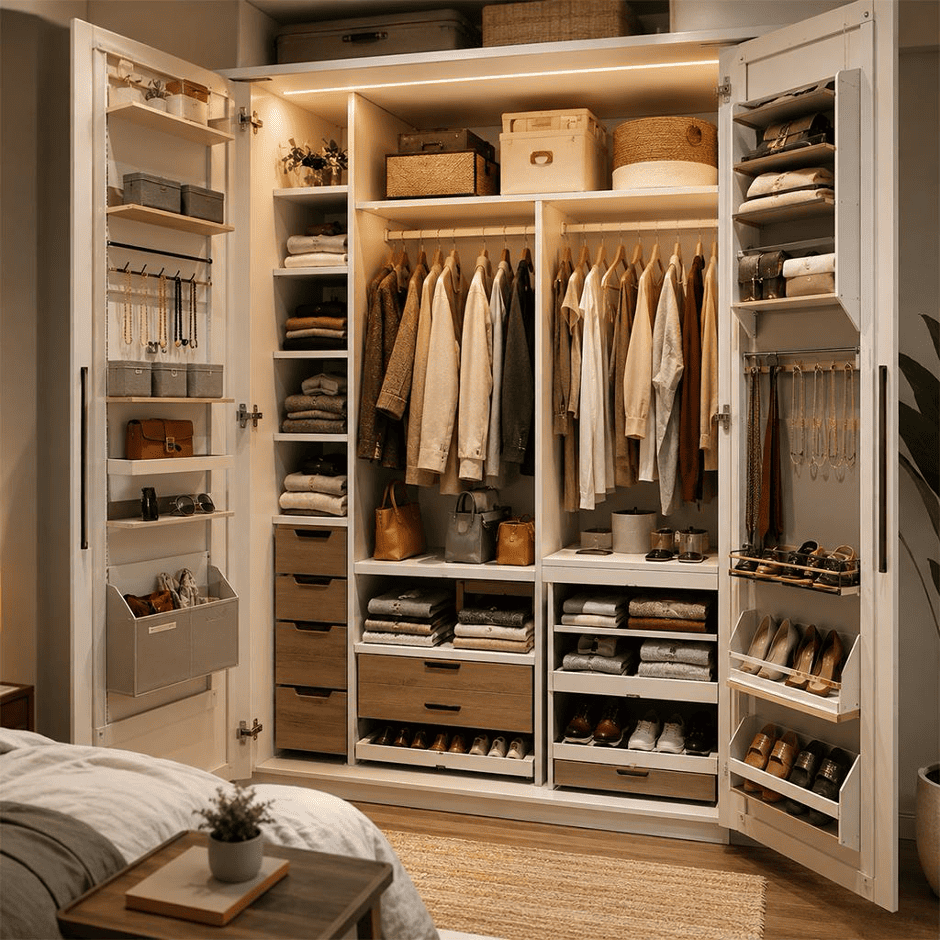
Introduction: Transforming Bedroom Storage with Smart Spatial Planning
Urban apartments are getting smaller. That’s not an editorial opinion — it’s a consistent pattern across major Indian cities, where new residential developments increasingly prioritize unit count over square footage. For residents, this means making difficult decisions about what to keep, where to store it, and how to prevent a small bedroom from feeling permanently overwhelmed by its own contents.
The capsule wardrobe concept has gained meaningful traction in response to this pressure. Rather than accumulating a large, loosely organized collection of clothing, the capsule approach focuses on a smaller number of pieces that work across multiple combinations and occasions. The result is a wardrobe that takes up less space, requires less daily decision-making, and sits more comfortably within a compact storage unit. Paired with minimalist design principles that prioritize function and clear sightlines, this approach can genuinely change how a bedroom feels to live in day to day.
Sustainable Wardrobe Habits: Quality Over Quantity
Fast fashion has created a specific storage problem: closets full of items that were purchased quickly, worn rarely, and never quite integrated into a workable daily rotation. Uncoordinated pieces in mismatched colors and weights create visual noise the moment the wardrobe door opens, and they occupy space that better-chosen garments would use more efficiently.
The shift toward buying fewer, higher-quality, longer-lasting pieces is not purely a sustainability argument — it is a practical storage argument too. A wardrobe built around core essentials in a consistent color palette requires less physical space and produces less daily friction. Getting dressed becomes straightforward rather than excavatory.
Building a master bedroom storage system around genuine wardrobe essentials also means the storage unit itself can be sized correctly from the start, rather than continually expanding to accommodate an ever-growing collection that outpaces the space available for it.
Concealed Architecture: Sleek Built-In Cupboards for Indian Bedrooms
The bedroom layouts most common in Indian apartments — rectangular rooms with substantial wall runs, often including alcoves beside windows or flanking bathroom walls — are genuinely well-suited to built-in storage. Floor-to-ceiling cabinetry along a full wall uses space that freestanding furniture cannot reach while creating a clean, unbroken exterior that reads as architecture rather than furniture.
A wooden wardrobe for clothes built into a wall alcove or fitted across a full bedroom elevation reclaims floor area that a freestanding unit would occupy and eliminates the visual gap between furniture top and ceiling — a gap that inevitably accumulates dust and becomes an informal shelf for items that have nowhere else to go.
Matching the exterior finish of built-in cabinetry to the existing room palette is worth the extra planning time. When a large storage unit shares its tone with the walls, flooring, or adjacent woodwork, it recedes visually rather than dominating the room.
Intelligent Internal Layouts: Maximising Hidden Square Footage
The exterior of a wardrobe matters far less than what happens inside it. A beautifully finished door concealing an inefficient interior still produces the daily frustration of items piled on top of each other, rail space wasted on single-width hanging, and accessories lost at the back of a deep shelf.
Functional interior fittings make a tangible difference. Dual hanging rails double the usable rod length in sections where only short garments hang. Pull-out accessory trays keep small items visible and accessible rather than buried. Dedicated sections for seasonal wear — winter layers, formal pieces used only occasionally — keep daily-use clothing unobstructed.
A wooden cupboard with shelves that includes integrated LED strip lighting at shelf edges solves a problem that affects almost every deep wardrobe: poor visibility. Items pushed toward the back of a shelf in inadequate light become invisible in practice, even when the wardrobe is technically well organized.
Material & Aesthetic Tips: Crafting Premium, Blended Cabinetry
Light wood laminates continue to dominate contemporary Indian bedroom design for practical reasons. They photograph well, age consistently, clean easily, and work alongside a wide range of wall colors and flooring materials. Handleless push-to-open panels have replaced traditional knob and pull hardware in many current builds, contributing a quieter exterior line that suits both traditional and contemporary room styles.
Neutral cabinetry tones — whites, warm greys, light natural wood — allow large structural units to read as background elements rather than focal points. In a small bedroom, this matters considerably. A wardrobe that blends into the wall leaves the room feeling open; one that contrasts sharply can make the space feel halved.
Sliding door configurations remain the most practical choice for rooms where bed placement limits swing clearance. They eliminate the spatial planning problem of hinged doors entirely while maintaining a clean, flat exterior profile.
Conclusion: Balancing Minimalism and Everyday Functionality
A capsule wardrobe and a well-planned storage unit address the same underlying problem from different directions — one by reducing the volume of items that need housing, the other by housing what remains as efficiently as possible. Together, they produce a bedroom that functions with genuine calm rather than one that requires daily management to keep from descending into disorder.
The relationship between a clutter-free physical environment and daily peace of mind is harder to quantify than square footage or wardrobe capacity, but it’s consistently reported by people who have made the change. A room that looks ordered when you wake up sets a different tone for the day ahead.
Investing in durable, well-planned closet systems also avoids the cycle of upgrading inadequate storage every few years. A well-built fitted wardrobe, sized correctly and fitted with functional internals from the start, tends to outlast the apartment’s occupancy — and to serve every resident who follows.